Manufacturers should not wait for final HTA scopes to test whether their evidence package can address the population, intervention, comparator and outcomes (PICO) requirements. A pivotal trial may answer the global clinical questions relevant to regulatory approval, without addressing payer-relevant research questions that HTA bodies will focus on. A mismatch between the PICOs of interest to HTA stakeholders and PICOs actually addressed by the asset’s evidence package can severely undermine value, price and reimbursement potential [1,2].
If companies identify those differences only when assessment scopes are confirmed and pivotal trials are locked in, it may invariably be too late to mitigate gaps. PICO forecasting is therefore about understanding the possible range of questions that the evidence package may need to address early on, to enable optimal evidence generation in order to fulfil HTA requirements and optimise value and access [1,2].
Why is waiting for the final PICO risky?
By the time the scope of a national assessment is confirmed, the manufacturer may find that the payer-relevant comparator was not built into the clinical programme. A subgroup may not be adequately represented in the trial population. A key outcome may not have been collected and cannot be analysed post-trial. An indirect treatment comparison may be infeasible because the evidence network is disconnected. These late-stage findings undermine the data’s relevance to HTAs and introduce substantial uncertainty for decision-makers about the therapy’s value in their local clinical context [1,3].
Using early PICO forecasting to avoid evidence gaps
PICO forecasting to inform evidence generation strategy before Phase 3 trials begin represents an important window where manufacturers can ensure the evidence package is fit for purpose and compatible with HTA value frameworks.
A systematic and robust methodology is needed to build a credible ‘PICO universe’. Given the diversity of standards of care and availability of medicines across countries, multiple PICOs can be expected. Once these are identified, progressively testing and narrowing the universe of options becomes the most important strategic step [2].
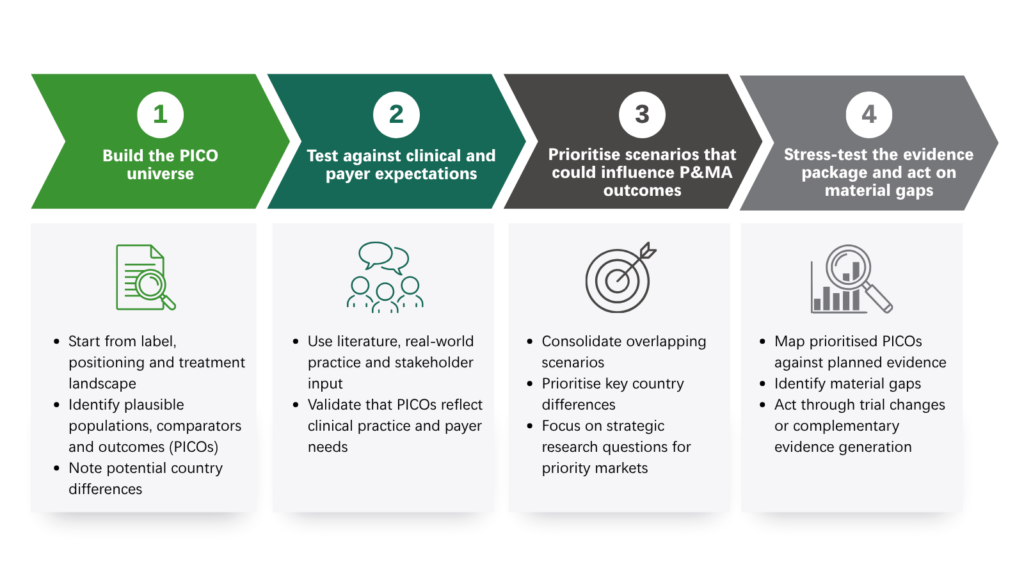
A practical approach can be summarised in four stages:
- Build the PICO universe. Start with the anticipated regulatory label, target positioning in the clinical pathway and the evolving treatment landscape. At this stage diverging evidence needs may become apparent across countries. The objective is to identify plausible populations, comparators and outcomes, along with the rationale behind them [2].
- Test against clinical and payer expectations. Structured literature research provides the foundation, but real-life clinical practice and payer input matter. Input from key stakehoders can test whether the proposed PICO scenarios reflect how patients are treated in clinical practice and what evidence is likely to be relevant.
- Prioritise scenarios that could influence P&MA outcomes in priority markets. Overlapping country scenarios can be consolidated, while diverging evidence needs can be prioritised, preserving meaningful national differences. This turns a long list of possibilities into a set of strategic research questions that can inform evidence investment decisions to address payer requirements where it matters most.
- Stress-test the evidence package and act on material gaps. Map the prioritised PICOs against the planned trial and wider evidence package. Where gaps remain, consider whether they should be addressed through changes to the clinical programme or through complementary evidence generation. For instance, for each anticipated PICO, manufacturers should determine in advance whether it will be addressed through:
- Direct comparative evidence
- Indirect treatment comparisons (ITCs)
- Alternative supporting evidence
- A deliberately managed and justified evidence gap
What does early JCA experience tells us about PICO misalignment?
Early concern was that JCAs would generate an unmanageable number of PICOs. In practice, completed JCAs to date have contained up to 12 PICOs. PICOs were generally aligned with clinical guidelines rather than being unexpectedly broad or “left field”, although some were off-label.
The published JCA for tovorafenib provides a useful illustration of what to expect in practice. Evidence was submitted for seven scoped PICOs. However, the evidence was considered sufficient for only one PICO because other analyses were either single-arm or failed methodological requirements. Whilst this case does not establish whether earlier forecasting would have resolved each gap, it reinforces the value of testing evidence readiness before the assessment stage.
Additionally, the lurbinectedin example showed that even a head-to-head study may not fully satisfy JCA expectations if the trial population differs from the final licensed population. Missing subgroups, differences in performance status, or exclusion of relevant patients can create evidence gaps despite having comparative trial data for the right PICOs.
Conclusion:
Predict PICOs early, map each PICO against the planned evidence package, identify gaps before final scoping, and decide whether gaps require additional evidence generation, an indirect comparison strategy, or a deliberate access-risk mitigation plan.
PICO forecasting cannot fully remove uncertainty from HTA. Its purpose is to make uncertainty manageable while allowing evidence-generation investment decisions to be prioritised. Manufacturers may not submit evidence for every predicted PICO, and for those they choose to submit, the optimal trial design, indirect-comparison methodology or risk-mitigation plan needs to be informed by clinical and payer stakeholders.
When the assessment time arrives, which PICOs could your evidence package confidently address? Which would require additional analysis and an evidence generation strategy? And which would expose a material evidence gap that will have to be defended during the HTA process?
Get in touch with our expert team to explore how Remap can help you answer those questions
References:
- European Commission. Joint Scientific Consultations. Public Health. Accessed 21 September 2026. https://health.ec.europa.eu/health-technology-assessment/implementation-regulation-health-technology-assessment/joint-scientific-consultations_en
- Member State Coordination Group on Health Technology Assessment. Guidance on the scoping process, Version 1.0. 13 November 2024; adopted 28 November 2024. https://health.ec.europa.eu/publications/guidance-scoping-process_en
- Member State Coordination Group on Health Technology Assessment. Practical Guideline for Quantitative Evidence Synthesis: Direct and Indirect Comparisons. 8 March 2024. https://health.ec.europa.eu/publications/practical-guideline-quantitative-evidence-synthesis-direct-and-indirect-comparisons_en
Frequently Asked Questions:
What is PICO forecasting in HTA?
PICO forecasting is the structured process of identifying the credible populations, interventions, comparators and outcomes that HTA bodies will expect a manufacturer to submit evidence for.
Why is waiting for the final HTA scope risky?
By the time a JCA or national HTA scope is confirmed, important evidence gaps may become apparent. For example, the clinical trial programme may lack relevant comparators, focus on a particular subgroup of limited relevance, omit a key outcome or provide poor support for an indirect treatment comparison. These gaps can increase payer uncertainty, in more material cases, can become a barrier to reimbursement or price potential.
When should manufacturers begin PICO forecasting?
Manufacturers should begin before the phase III protocol is finalised. Starting at this point gives teams time to assess likely payer questions and decide whether material gaps require changes to the clinical programme or complementary evidence generation.
How should manufacturers forecast PICOs?
Start by building a credible PICO universe from the anticipated label population, positioning in the treatment pathway and evolving treatment landscape. Then, test and validate country-specific assumptions with clinical and payer stakeholders to ensure your evidence plans are relevant to both clinical practice and HTA requirements. Consolidate overlapping country scenarios and resolve conflicting assumptions while preserving meaningful differences. Lastly, prioritise the research questions that could materially change the asset’s price and market access potential.
How does PICO forecasting help identify evidence gaps?
Teams can map prioritised PICO scenarios against the planned trial and wider evidence package. This shows which questions are already addressed and where evidence is missing. Manufacturers can then decide whether to modify the clinical programme, plan additional analyses or generate complementary evidence before the opportunity to act has narrowed.