Pricing strategy is often treated as a launch activity. However, by the time teams begin detailed price planning, many of the decisions that shape future pricing flexibility have already been made. Population, comparator and endpoint decisions that are made before Phase 3 trials commence – not only shape the regulatory evidence package – but also shape the value proposition that payers and HTA bodies will evaluate.
The strategic challenge for manufacturers is therefore not simply how to start pricing work earlier. It is about ensuring that evidence, access, and value trade-offs are transparently understood across functions at a stage when development choices remain flexible and open to adjustment.
The achievable price corridor is shaped very early on
While commercial and regulatory teams may favour a broad label to maximise the addressable patient population and future market opportunity, clinical development teams often prioritise a specific well-defined trial population to demonstrate a clear and statistically robust treatment effect. However, significant pricing and access risk can arise when the eventual regulatory label is much broader than the population studied in clinical trials.
By focusing on a more homogeneous patient group, trials can reduce variability, improve the signal-to-noise ratio, and generate stronger efficacy and safety evidence. Nonetheless, a therapy that is highly differentiated in one subgroup may appear less compelling across a wider population.
In these cases, the product may still achieve regulatory approval based on the totality of evidence but will enter launch with a weaker evidence base. Payers typically focus on the uncertainties around the generalisability of trial results in clinical practice, restricting achievable price and breadth of access.
Often, the issue is not whether the product can gain regulatory approval, but whether the evidence package can support the intended value proposition across the whole breadth of the target population where the company expects to achieve its price goals.
Europe makes the pricing consequences especially visible
This risk exists across European markets, for example, in Germany and in Italy, where the respective clinical benefit or innovative status assessments are directly linked to price-setting mechanisms.
A broad EU-authorised label can expand the population considered in the HTA assessment, and payers may seek price concessions to compensate for uncertainty in subgroups not fully represented in the trial population. This can create significant global price risks, since European list prices are broadly referenced internationally.
Launch-stage evidence rarely fully repairs lost pricing flexibility
If EU payer-relevant evidence is not built into pivotal trials, launch teams may be left trying to recover the pricing story through reactive strategies and supplementary suboptimal evidence.
Real-world evidence, indirect treatment comparisons and external control arms can all play an important role. However, while these approaches can be useful, they are often costly, time-consuming and less persuasive than robust evidence generated prospectively within the pivotal development programme.
This does not mean every HTA evidence expectation can realistically be addressed before launch. Development timelines, regulatory requirements, trial feasibility and patient recruitment all matter. However, the pricing consequences of these trade-offs should be made visible cross-functionally before pivotal plans are finalised.
Conclusion
The price corridor is not set at launch. It is built, defined and protected through decisions on population, comparators, endpoints and evidence generation years before negotiation begins.
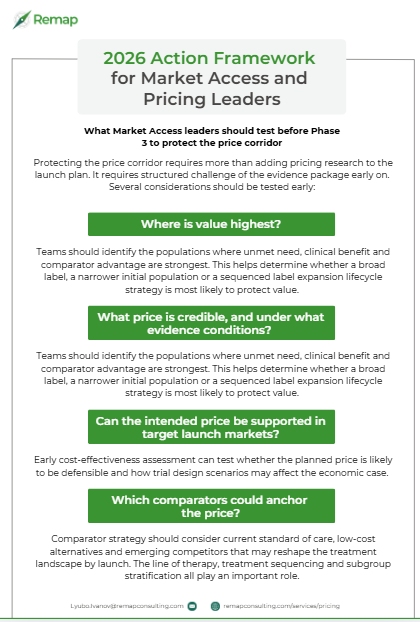
To help teams assess whether pricing implications are being embedded early enough, Remap has developed a practical framework for reviewing:
- evidence and access alignment
- launch sequencing risk
- pricing governance
- affordability exposure
- corridor protection assumptions
Download: 2026 Action Framework for Market Access and Pricing Leaders
The framework outlines key questions and strategic actions for teams reviewing pricing and market access readiness across development and launch planning.
Frequently Asked Questions About Early Pricing Strategy
When should pricing strategy begin in drug development?
Pricing strategy should begin before pivotal trials commence, when decisions on population, comparator, endpoints and evidence generation can still be shaped. If pricing is treated only as a launch activity, teams may inherit an evidence package that supports regulatory approval but does not fully defend the intended price or reimbursement position.
What is a pricing corridor in pharma?
A pricing corridor is the range of potential prices a pharmaceutical product can realistically achieve in reimbursement negotiations. It is shaped by the robustness of the value story and level of uncertainty.
Why does clinical positioning matter for HTA and pricing?
Clinical positioning matters because HTA bodies and payers assess value relative to available alternatives. If a pharmaceutical product is compared against a low-cost or highly effective standard of care, the level of price premium a manufacturer can credibly defend may be more limited.
Does a broad regulatory label always reduce pricing potential?
A broad label can support patient access and commercial opportunity, but it can also create pricing risk when the breadth of the label exceeds the breadth of the evidence supporting the value narrative, as well as increasing budget impact concerns.
How can manufacturers protect the price corridor before launch?
Manufacturers can protect the price corridor by testing payer-relevant evidence decisions before pivotal trial design is finalised. This includes pressure-testing positioning and endpoint choices, using early economic modelling, and engaging with payers early on to identify mitigating strategies to address unavoidable areas of uncertainty.