The price of innovative, next generation therapies has outpaced payer budgets for some time now, resulting in declining payer’s appetite for risk. As a result, market access leaders have looked for outcomes-based agreements (OBAs) to share the risk, enabling payers to reassess the therapy’s value beyond clinical trials against pre-determined outcomes. In theory, OBAs provide a practical solution to deal with payer uncertainty. However, in practice, implementation is complex. Here, we discuss the practicality of OBA implementation and examine a case study that illustrates how the link between OBAs and access potential is not always clear cut.
What are outcomes-based agreements?
Outcomes-based agreements (OBAs) are a subset of manage-entry agreements, distinguished by the integration of clinical or real-world outcomes as the basis for financial risk-sharing. rather than relying solely on financial terms like discounts, caps, or price-volume mechanisms. OBAs are most often used when there is uncertainty around real-world outcomes1. OBAs can be implemented in a number of different ways, some key examples include2:
- Payment by result (PbR); payment is reduced (or refunded) if agreed outcomes are not achieved by a set time point.
- Conditional treatment continuation (CTC): continued coverage or staged payments dependent on whether patients reach pre-defined interim outcomes (often patient level “responders” vs “non-responders”).
- Payment by responder: payments are linked to the number/percentage of patients meeting a pre-defined responder threshold by a set time point; payment is reduced (or rebated) for non-responders.
Why do OBAs appeal in rare disease and advanced therapy launches?
OBAs address some key issues that come up repeatedly for one-off therapies, making them attractive to payers:
- They share risk when evidence is still maturing1. Rare disease trials are often small and OBAs provide payers with some protection if outcomes observed in trials do not hold up in practice. However, this approach is only justifiable when larger trials are not clinically or ethically feasible. When OBAs are proposed as a mitigation strategy, in response to immature or incomplete evidence packages, it can undermine goodwill during payer negotiations. Although OBAs in rare disease launches can help share risk, they cannot create agreement on value where the underlying evidence and positioning do not hold.
- They support managed entry when uncertainty is measurable2. If the key question can be assessed within a clear window (e.g., transfusion independence at 12–24 months), an OBA sets a pre-agreed condition for therapy funding. This directly manages budget risk by enabling access without requiring an all-or-nothing reimbursement decision at launch, and help lower initial payer reluctance.
- They can incentivise outcomes that matter to patients and payers3. By linking payment to payer-relevant and clinically meaningful endpoints, OBAs incentivise access to therapies that can provide meaningful real-world impact.
Why OBAs don’t always translate into access?
For payer decision-makers, there are three recurring problems associated with OBAs for high-cost therapies:
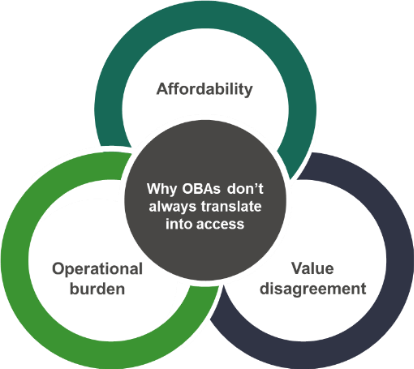
- Affordability – Even with a financial risk-sharing clause, a payer may still face a large upfront payment or overall budget-impact that annual budgets cannot absorb.
- Value disagreement1 – OBAs cannot replace a robust and credible value proposition and well-defined positioning in the treatment pathway. Without alignment on the value of a product, an OBA can become a detour; which unavoidably fails to change the decision outcome.
- Operational burden4 – OBAs require ongoing outcome measurement, involving data capture and validation. In rare diseases, with small patient numbers and specialist pathways, with therapies administered within reference centres, data collection can be easily implemented. However, in indications with larger population sizes and broader use, patient monitoring requirements can rapidly become unfeasible or economically inviable.
Case study: Zynteglo® in context
Zynteglo® combined a one-time “potentially curative” claim for transfusion-dependant adult and paediatric patients with β-thalassemia, with a very large upfront cost; making it a high-profile test of whether OBAs genuinely enable payer adoption (and under what conditions they fail)7,8.
What ‘outcomes-based’ looked like in practice for Zynteglo®
US markets: high list price with a performance guarantee
In the US, Zynteglo® launched with a reported wholesale acquisition cost of $2.8 million. In practice, Zynteglo® has been positioned as an outcomes-based agreement (to manage short-term non-response risk), as an effort to make the high one-time cost more manageable. The PbR outcomes-based offer involved up to an 80% refund if patients do not achieve and maintain transfusion independence during the 2 years post-infusion10.
In company updates, Genetix Biotherapeutics has stated that outcomes-based agreements are in place for Zynteglo® with both commercial and Medicaid payers, covering 200+ million US lives through contracts or favourable coverage policies, and reporting “zero ultimate denials” across Medicaid and commercial payers11.
Europe: a five-year instalment approach linked to outcomes
In Europe, Zynteglo® received conditional marketing authorisation on 29 May 20199. Bluebird Bio priced Zynteglo® at $1.8 million in Europe and offered a outcomes-based agreement, specifically a CTC, which spread the cost of the treatment over five equal yearly payments: €315,000 per year, with later instalments contingent on continued treatment (transfusion independence)12
Despite this, broad and sustainable reimbursement across European markets did not materialise. In August 2021, bluebird bio announced it would wind down operations in Europe, citing challenges in achieving appropriate value recognition and market access13. The EMA later documented withdrawal on 24 March 2022 at the company’s request and discontinuation for commercial reasons14.
What Zynteglo® ’s withdrawal teaches rare disease launches
Zynteglo® ’s withdrawal from Europe highlights three practical lessons that are highly transferable to other high-cost rare disease and advanced therapy launches:

Durability uncertainty needs an evidence plan, not just a refund clause
For one-time therapies, a two-year refund can reduce payer risk in the short term, but it does not answer the questions that drive most reimbursement decisions: how durable is the benefit?, what are the long-term risks?, and how does value look over a 5–10-year horizon? This is where planning long-term follow-up, registry strategy, and clear reporting commitments become part of the access case.
Zynteglo® illustrates how evidence gaps can undermine confidence:
- Long-term follow-up is being collected in an ongoing study, assessing patients who have received Zynteglo® for up to 13 years8. However, these data were immature at launch, leaving uncertainty about the long-term consequences of Zynteglo®, particularly given the theoretical risk of haematological malignancies9.
- Payer confidence can be eroded when manufacturer assumptions do not reflect current clinical practice, with the updated standard of care not being represented in the manufacturer’s assessment4.
- Health-related quality of life data collected in trials were not made available in a way that supported payer assessment. This lack of transparency led to questions about the therapy’s patient impact, weakening confidence in real-world patient benefits4.
Operational Feasibility: Data, Delivery, and the Limits of OBAs
Data and delivery must be built into the launch plan from day one; particularly for ATMPs where access depends on both clinical value and the feasibility of measurement and follow-up within routine care. An OBA only works if outcomes can be captured and validated and it is clear who is responsible for this, without creating an excessive burden on health systems4.
Zynteglo® illustrates this directly: delivery requires specialist-centre (QTC) coordination, which already stretches health-system processes before an OBA’s data requirements are added16. In rare diseases with small cohorts, longitudinal endpoints (e.g., transfusion independence) can be clinically clear but administratively difficult to monitor consistently across centres and payers. Without data infrastructure and governance, the operational burden of OBAs becomes a barrier and payers may discount the attractiveness of an OBA even when pricing terms look reasonable4.
Does feasibility of outcomes-based agreements vary by market?
As demonstrated by the Zynteglo® case study, the implementation of an OBA is likely to be more successful in markets with less acute cost/budget pressures and fragmented decision making4.
Whereas, European access is tightly shaped by:
- More rigid cost-containment measures – In lower-funded environments, payers tend to be more risk-averse, which reduces appetite for operationally complex OBAs unless the underlying value case is already clear.
- Additional evidence thresholds and budget/affordability considerations, as determined by HTA and subsequent price-setting processes – Where value and budget impact are misaligned with the standards of a system, an OBA rarely resolves access, as demonstrated when Zynteglo® was ultimately withdrawn after failing to reach a price agreement in Germany.
Key takeaway from Zynteglo®
OBAs are often presented as the ‘silver bullet solution’ for one-off, high-cost therapies. However, Zynteglo® demonstrates why: even with OBAs, access can stall if the wider launch plan is not built for payer reality. An OBA can share risk, but it cannot fix a launch where value, evidence, data and delivery are not aligned. For rare disease launches, the most credible OBAs are those used as a final step, placed on top of a wider launch plan that is “payer ready.”
Remap partners with companies to bridge this gap and bring one-off, high-cost therapies to market by providing evidence-generation and reimbursement expertise. Get in touch with us.
References
- Garrison LP Jr, Towse A, Briggs A, et al. Performance-based risk-sharing arrangements—good practices for design, implementation, and evaluation: report of the ISPOR Good Practices for Performance-Based Risk-Sharing Arrangements Task Force. Value Health. 2013;16(5):703–719.
- Outcomes-Based Agreements in Healthcare: A Comprehensive Analysis [Internet]. MedTechNews. 2025 [cited 2026 Feb 2]. Available from: https://medtechnews.uk/research-reports/outcomes-based-agreements-in-healthcare-a-comprehensive-analysis/
- It Takes 2 to Tango. Setting out the conditions in which performance-based risk-sharing arrangements can add value. Value Health. 2024.
- A systematic review of challenges and opportunities in outcome-based agreements (incl. ATMP context). Health Policy. 2024.
- Standards for the Clinical Care of Children and Adults Living with Thalassaemia in the UK (4th ed.). UK Thalassaemia Society; 2023.
- Udeze C, Evans KA, Yang Y, et al. Projected lifetime economic burden of transfusion dependent beta-thalassaemia (TDT) in the United States [Internet]. EHA Library; 2022 [cited 2026 Jan 22]. Available from: https://library.ehaweb.org/eha/2022/eha2022-congress/359190/
- How ZYNTEGLO® (betibeglogene autotemcel) Works [Internet]. www.zynteglo.com. Available from: https://www.zynteglo.com/how-zynteglo-gene-therapy-works
- U.S. Food and Drug Administration. ZYNTEGLO (betibeglogene autotemcel) [Internet]. Silver Spring (MD): FDA; 2022 [cited 2026 Jan 22]. Available from: https://www.fda.gov/vaccines-blood-biologics/zynteglo
- European Medicines Agency. Zynteglo: EPAR – medicine overview [Internet]. Amsterdam: EMA; 2022 [cited 2026 Jan 22]. Available from: https://www.ema.europa.eu/en/medicines/human/EPAR/zynteglo
- BioPharma Dive. With $2.8M gene therapy, Bluebird sets new bar for US drug pricing [Internet]. 2022 Aug 18 [cited 2026 Jan 22]. Available from: https://www.biopharmadive.com/news/bluebird-bio-gene-therapy-price-zynteglo-million/629967/
- bluebird bio. Highlight’s from bluebird bio’s corporate update JPM24 [Internet]. 2024. Available from: https://www.linkedin.com/posts/bluebirdbio_highlights-from-bluebirds-jpm24-corporate-activity-7150110834042568705-Sjmn/
- Fierce Pharma. Bluebird prices gene therapy Zynteglo at €1.575M in Europe, to be paid over 5 years [Internet]. 2019 Jun 14 [cited 2026 Jan 22]. Available from: https://www.fiercepharma.com/pharma/bluebird-prices-gene-therapy-zynteglo-at-eu1-575m-europe-to-be-paid-over-5-years
- Fierce Pharma. With the pricing situation “untenable” in Europe, bluebird will wind down its operations in the “broken” market [Internet]. 2021 Aug 9 [cited 2026 Jan 22]. Available from: https://www.fiercepharma.com/pharma/situation-untenable-bluebird-will-wind-down-its-operations-broken-europe
- Public statement [Internet]. Available from: https://www.ema.europa.eu/en/documents/public-statement/public-statement-zynteglo-withdrawal-marketing-authorisation-european-union_en.pdf
- bluebird bio, Inc. bluebird bio Provides Update on Severe Genetic Disease Programs and Business Operations [Exhibit 99.1 press release]. April 20, 2021. U.S. Securities and Exchange Commission (SEC) EDGAR. Available from: https://www.sec.gov/Archives/edgar/data/1293971/000129397121000030/exhibit99120210420.htm
- bluebird bio, Inc. bluebird bio J.P. Morgan Presentation [Internet]. January 2024. U.S. Securities and Exchange Commission (SEC) EDGAR; Exhibit 99.2. Available from: https://www.sec.gov/Archives/edgar/data/1293971/000129397124000004/ex992_jpm.htm