Pricing research is often treated as a launch-stage exercise focused on testing a target price. But at that point decisions around the patient population, comparators, endpoints and evidence package may already have been locked, and opportunities to optimise the asset’s value strategy may be limited.
Starting earlier does not mean fixing a price earlier, but rather using payer research to progressively shed light on credible options and key value levers while teams can still act on the findings. For example, for Phase 1 and 2 assets, the pricing corridor may be deliberately broad. As evidence develops, local payer expectations become clearer and market interdependencies are understood, the relevant trade-offs can be decided more explicitly, and as a result, the pricing position becomes gradually narrower.
The purpose of early pricing research is to provide a holistic view on what drives payer value and how to reduce payer uncertainty. Targeted payer engagement, if conducted at the right time, can inform manufacturers of realistic scenarios and the likely trade-offs between price ambition, breadth of access and speed to market – helping to reduce downstream launch risks.
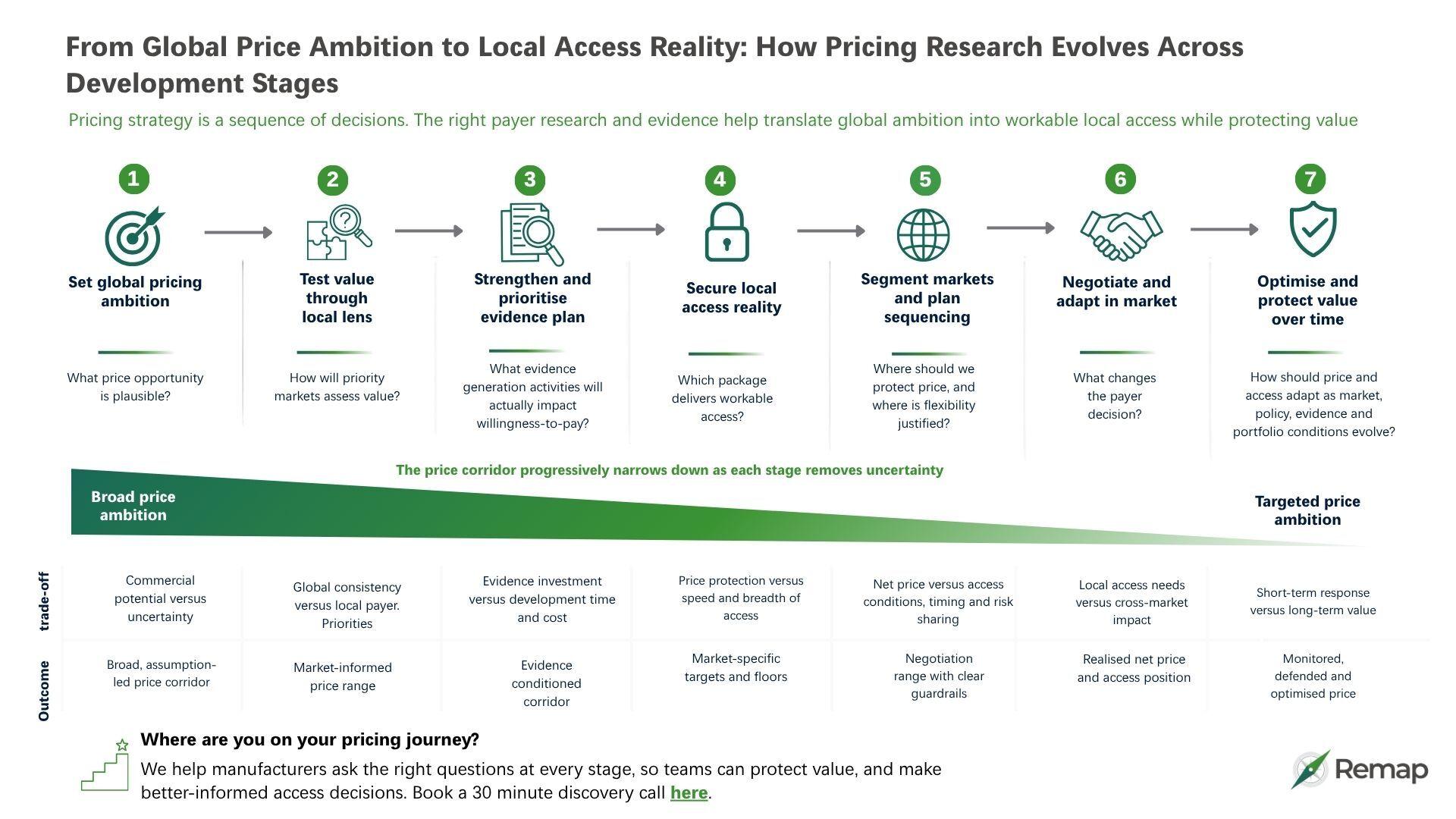
The price corridor should progressively narrow down as each stage removes uncertainty
- Early work tests the size of the opportunity, explores key value drivers, identifies appropriate comparators and assesses broad willingness to pay. Payer research should focus on how local decision-makers may respond to different target product profiles, what evidence is needed to defend a broad value bracket, and what the price floors and ceilings are, depending on evidence scenarios.
- As the product profile and cross-functional alignment advances, payer research should test evidence and access trade-offs, risk mitigation strategies and additional activities to support launch.
- Closer to launch, the focus shifts towards payer thresholds, likely objections, contracting options and negotiation levers.
- Post-launch research focuses on anticipating competitive and market pressures that erode price ambition, and shed light on strategies to protect value over time
Pricing strategy consists of a sequence of decisions. A common pitfall is that using the same standard payer research approach at every stage may provide high-level insights that do not support a real decision.
Figure 1 illustrates how the pricing research typically evolves through seven interconnected stages. Ultimately, pricing strategy should move from broad ambition to a targeted price and access position, supported by evidence informed by early payer insight. Finally, a value strategy needs to be forward-looking and continuously protected over time.
What next? Delve deeper!
This quarter, Remap have explored the different phases of pricing research and the importance of each, depending on the stage of your pricing journey.
- Choosing payer pricing research? Start with the question, not the methodology
- The Hidden Risk in Pharma Pricing: When Poor Governance Undermines Commercial Ambition
- Defending Price Under HTA Scrutiny: Why Evidence Must Be Designed to Match Payer Priorities
- Why Pricing Strategy Must Start Earlier: Linking Evidence, Access, and Value from Day One
Not sure what the right payer research approach looks like for your asset?
Regardless of the stage of development, consider these five strategic questions before starting any price research:
- Is your organisation aligned cross-functionally on how the asset could create meaningful differentiation for patients, payers and health systems?
- Is there a unified view on what the long-term value ambition for the asset is in light of the evolving competitive and policy environment?
- Which markets should be prioritised based on their role in creating, influencing or protecting value, and what key strategic question should each market answer?
- Where can payer insights still influence the asset and evidence strategy, and what degree of change is feasible within development timelines?
- Which organisational objective should anchor the research scenarios: price, breadth of access or speed to market, and what trade-offs are acceptable?
Schedule a short introductory call with the Remap team.
We will explore what you need to learn, discuss potential scope and methodology and flag common pitfalls. If there is a good fit, we can agree a next step. If not, we will say so. No sales pitch, just a practical conversation.