When the Voluntary Scheme for Branded Medicines Pricing, Access and Growth (VPAG) replaced VPAS in 2024, it was intended to provide a more sustainable framework between the NHS and the pharmaceutical industry.
However, the scheme quickly came under pressure as rising and unpredictable clawbacks intensified concerns about UK launch economics and investment. Manufacturers increasingly questioned the sustainability of the commercial environment, with some reconsidering UK launch priorities and continued participation in the voluntary scheme.
Just two years after the latest major reform of the voluntary scheme, VPAG itself was already facing the need for fundamental change. It remains in force today, but its replacement is now being actively designed.
Why does the current VPAG scheme need reform?
Under VPAG, pharmaceutical companies were required to pay a proportion of eligible branded medicine sales back to the government
The scheme comprised two components: a core affordability payment, with the rate increasing where medicines sales grew faster than the agreed NHS spending envelope, set at 3.75% in 2025, and a separate Investment Programme contribution used to support investment in UK clinical trials, manufacturing and health technology assessment.
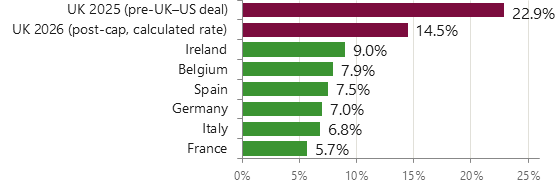
In 2025, the headline payment rate, the proportion of eligible newer medicine sales that companies were required to pay back under VPAG’s core affordability mechanism, reached 22.9%, or 23.5% including the Investment Programme contribution, compared with the 15.9% originally anticipated on the same combined basis1.
The ABPI argued that this left the UK materially out of line with comparable European markets, where average pharmaceutical clawback rates were 5.7% in France, 6.8% in Italy, 7.0% in Germany, 7.5% in Spain, 7.9% in Belgium and 9.0% in Ireland.
It warned that the higher-than-expected rate risked undermining the sustainability and competitiveness of the UK’s medicines pricing framework. From the UK government’s perspective, however, the increase reflected substantially higher-than-expected growth in branded medicines expenditure, requiring a higher payment rate to keep spending within the envelope agreed under VPAG.
Although clawback schemes are not directly comparable, given differences in healthcare funding, pricing arrangements and expenditure-control mechanisms, the gap between UK and the rest of Europe nevertheless highlights the acute commercial pressure facing manufacturers in the UK.
Figure 1: Pharmaceutical clawback / rebate rates: UK vs Europe
Source: ABPI1; DHSC / VPAG announcements (2025, 2026)2
The issue was not only the level of the payment, but also its unpredictability
The introduction of a clawback rate materially above what had been previously forecast sets a precedent and makes it harder for manufacturers to assess future UK net revenues, plan launch sequencing and make investment decisions. These were risks we highlighted in our earlier analysis “VPAG for manufacturers: boom or gloom for UK launch”. An accelerated review in 2025 failed to produce an agreed solution, but the subsequent UK–US pharmaceutical pricing arrangement established a formal pathway to replace VPAG from 2029.
Did Trump just fix VPAG?
Finalised in April 2026, the arrangement provided some immediate relief while formally committing the government to developing a new scheme to replace VPAG from 1 January 20293.
For the remainder of the current VPAG, the agreement caps the headline payment rate for newer medicines at 15%. The separate VPAG Investment Programme contribution cannot exceed 1%, meaning the combined portfolio-wide rebate on new medicines cannot exceed 16%. The calculated VPAG headline rate for 2026 is actually lower, at 14.5%2,3.
More importantly, the deal sets out some of the principles that should be considered for VPAG’s successor. An industry-government working group has been tasked with exploring3:
- outcomes-based payments
- a clearer link between the scheme and wider industrial policy
- substantially lower clawback rates for medicines meeting specified conditions
- potential further refinement of differential quality-adjusted life year (QALY) thresholds for different medicines
The timetable is also defined. Replacement options were due to be identified for piloting by June 2026, pilots launched from September 2026 and initial results assessed by September 2027. Final terms are due by 30 June 2028 ahead of implementation in January 20293.
So, while the design remains uncertain, replacing VPAG is no longer hypothetical.
What could the successor scheme look like?
The UK–US agreement tells us relatively little about how these principles will translate into commercial terms. There is no confirmed rebate rate from 2029, and we currently don’t know whether the successor will retain one headline payment rate, introduce several tiers or allow more product-specific commercial arrangements. Most importantly, the government has not defined which medicines will qualify for the promised ‘substantially lower claw-back rates’3.
That creates several possibilities for a possible successor scheme. Preferential treatment could be linked to therapeutic innovation, high unmet need, disease severity or outcomes achieved in NHS practice. Alternatively, the explicit reference to industrial policy could mean that UK clinical research, manufacturing, infrastructure or wider investment plays some role in determining commercial treatment.
These possibilities remain speculative. However, the wording of the agreement suggests the future debate may be less about identifying one appropriate rebate percentage and more about whether different medicines should receive different treatment in the first place.
Outcomes-based arrangements could form one part of that model. As we have explored previously in Outcomes-Based Agreements Aren’t a Silver Bullet, linking payment to realised outcomes can help manage uncertainty, but requires suitable endpoints, data infrastructure and workable contracting mechanisms.
VPAG reform is also taking place alongside a broader attempt to improve the UK commercial environment
Under the same UK–US agreement, the government committed to increasing spending on new medicines from around 0.3% of GDP in 2026 to at least 0.6% by 2036, while NICE’s standard cost-effectiveness range rose from £20,000–£30,000 to £25,000–£35,000 per QALY3.
The agreement also specifies that higher net medicine prices should not simply be offset through increased portfolio-wide rebates3. This highlights a key challenge for any VPAG successor: supporting greater access to innovative medicines without automatically offsetting that progress through higher industry repayments. Reform may therefore need to address not only the headline rebate percentage, but the underlying expenditure-control mechanism itself.
These changes also need to be viewed in the context of a wider shift in global pharmaceutical pricing. US Most-Favoured-Nation policy is explicitly seeking to reduce the extent to which higher US revenues support lower returns in other developed markets, increasing pressure on countries such as the UK to contribute more to the funding of pharmaceutical innovation.
What does this mean for pharma manufacturers?
VPAG is therefore not dead yet. It remains in force until 31 December 2028, but manufacturers should not assume that the current 15% ceiling will continue beyond 2028. Equally, they should not assume that VPAG will simply be replaced by a universally lower rate. For launches approaching 2029, scenario planning should consider both conventional portfolio-wide rebates and more differentiated models.
Evidence demonstrating real-world outcomes, productivity or wider system value could also become increasingly commercially relevant. If industrial policy considerations influence future terms, UK research, manufacturing and pathway investments may become more closely connected to market access strategy.
The potential successor scheme looks fundamentally set to change what the UK chooses to reward through its medicines pricing system, shifting the focus from how much industry should pay back towards which medicines and investments the UK wants its commercial framework to reward. For pharmaceutical companies planning future UK launches, understanding what could qualify a medicine for more favourable commercial treatment may become just as important as forecasting the rebate itself.
Remap Consulting supports pharmaceutical and biotechnology companies in navigating UK pricing and market access, from early pricing and evidence strategy through to NICE appraisal and commercialisation. If you are looking to discuss how evolving VPAG reforms could affect your UK launch and pricing strategy, book a free initial call with a Remap expert
References:
- Association of the British Pharmaceutical Industry. Why is the 2025 rate so much higher than expected? VPAG report. 20 March 2025.
- Department of Health and Social Care. Response to consultation on changes to headline payment percentage and approach to consultations of the statutory scheme to control the cost of branded health service medicines. 10 June 2026.
- UK Government. Arrangement between the United States of America and the United Kingdom on pharmaceutical pricing. 2 April 2026.