Early HTA scientific advice reduces price and reimbursement risk by informing evidence development and ensuring it meets payer requirements
Manufacturers often encounter restricted reimbursement, delayed access, or pricing pressure when their asset’s evidence package fails to meet payer HTA expectations. Indeed, regulatory success does not guarantee HTA success; and early scientific advice is a crucial step for incorporating payer evidence requirements before pivotal trial design choices are locked in.
Incorporating payer evidence needs early on is fundamental for the robustness of the data package and its ability to support optimal price and access negotiations at launch. Early scientific advice is most valuable when it informs decisions that cannot easily be corrected once trials are underway.
Early advice reduces risk across four core areas
Time and time again, the main four areas where trial design undermines HTA outcomes are: inappropriate choice of comparators, narrower trial population than the population targeted in clinical practice, choice of endpoints that are not valued or accepted by payers, and uncertainty in economic modelling.
Comparators
Demonstrating incremental benefit depends on an appropriate comparator, but the standard of care varies across countries. Early advice helps confirm which comparators will be appropriate in priority markets, while the trial design can still be adapted. This includes identifying comparators which may differ across patient subgroups. Where only single-arm trials or external controls are feasible, advice helps shape the comparison strategy and plan how bias can be addressed to withstand HTA scrutiny.
Population
HTA bodies assess whether trial populations reflect the patients likely to be treated in practice. Early scientific advice can align inclusion criteria with real-world use and identify subgroup analyses needed for HTA applications. This is particularly important in limited populations, rare diseases and basket trials, where generalisability is often a key concern.
Endpoints
Endpoints accepted for regulatory approval do not necessarily meet the evidentiary standards applied by HTA bodies. For reimbursement decision-making, payers typically place greater weight on objective, patient-relevant outcomes such as overall survival, morbidity and health-related quality of life. By contrast, more subjective measures, including caregiver-reported HRQoL, and surrogate endpoints used to infer long-term benefit are often viewed more cautiously and may be given limited weight or rejected where their relevance to patient outcomes has not been robustly validated.
In a retrospective study of German benefit assessments, G-BA accepted the primary endpoints used by the EMA in only 55% of cases, and endpoint acceptance was associated with a higher probability of an additional benefit rating.[1] Early advice tests whether outcomes are meaningful to payers and whether evidence supporting surrogates is likely to be accepted. When overall survival or long-term outcomes are immature at launch, early advice can guide extrapolations and future plans for post-launch evidence collection.
Economic modelling
HTA requirements for cost-effectiveness vary considerably across European markets and are heavily influenced by the nature, maturity and relevance of the clinical evidence generated in trials. Differences in national expectations around comparator selection, time horizon, utility measurement, resource use, treatment duration, waning of effect and handling of uncertainty mean that an approach considered acceptable in one market may not be persuasive in another. Early advice can therefore play a critical role in shaping the economic evidence strategy, including model structure, key assumptions, data inputs and scenario analyses, as well as the approach to extrapolating immature outcomes. This helps ensure that the model is not only technically robust, but also aligned with payer expectations, local decision-making frameworks and the evidentiary standards used to assess value at launch.
Misalignment of these decisions can undermine HTA success
Recent HTA experience shows that where evidence generation and development decisions are not aligned with payer expectations, the consequences can weaken both the clinical and economic case presented at assessment. In practice, uncertainty in the evidence package invariably leads to reduced confidence in the claimed value proposition, and ultimately a weaker negotiating instance for manufacturers.
Indeed, several examples of recent HTAs indicate misalignment between trial design and payer evidence requirements:
| Trial design area | Misalignment | HTA consequence | Recent HTA example |
|---|---|---|---|
| Comparator | Trial comparator absent or does not reflect national practice | Added benefit may not be recognised Value proposition may rely on indirect evidence | Tarlatamab (NICE): No head-to-head comparator evidence, so the submission relied on an unanchored MAIC, which was deemed uncertain.[2] Tislelizumab oesophageal (G-BA): Added benefit not proven where the chosen comparator did not align with that specified by G-BA.[3] Tislelizumab NSCLC (G-BA) Added benefit not proven, study comparator only considered suitable for PD-L1-negative tumours, so only this subpopulation was relevant for assessment.[4] |
| Populations | Trial populations do not reflect patients treated in practice | Poor generalisability | Encorafenib plus binimetinib (NICE): Generalisability concerns where trial population had ECOG 0-1, but around 25% of NHS patients treated with the indirect comparator have ECOG 2.[5] |
| Endpoints | Trial endpoints are immature, not patient-relevant or rely predominantly on surrogate endpoints | Claimed benefits from endpoints may not be accepted or may be deemed uncertain | Tarlatamab (NICE): Short follow-up for PFS and OS increased uncertainty in the clinical case.[2] Tislelizumab NSCLC (G-BA): PFS not statistically significant, G-BA highlighted uncertainty around patient relevance due to basing morbidity on radiology results rather than symptoms.[4] |
| Economic modelling | Economic model uses assumptions or approaches misaligned with HTA expectations | Cost-effectiveness is inconclusive or below thresholds | Encorafenib plus binimetinib (NICE): Uncertainties in the unanchored MAIC and long-term outcome extrapolations prevented the determination of the most-likely cost-effectiveness estimate.[5] |
Timing of scientific advice is critical
European countries such as the UK, Germany and France all offer national HTA early advice. In France, HAS should be engaged prior to pivotal trials commencing and within published timetabled slots.[6] G-BA in Germany also operates timetabled slots.[7] Whereas, NICE has the most flexibility, offering contact at any point in the development.[8]
All bodies offer early scientific advice, but the level of methodological design advice differs. For instance, NICE offers scientific advice on health economics and a separate health economic model assessment service; HAS addresses health economics questions in early dialogue. By contrast, G-BA emphasises submitted evidence, studies and comparator therapy, and does not prominently offer a comparable health economics advice service. Some national HTA services can also be combined with regulatory bodies and other markets, with NICE offering joint MHRA advice and joint Canadian HTA advice.[8]
Delaying engagement can narrow the options available in some markets and reduce the opportunity to align development plans with national HTA expectations
Early scientific advice reduces risk of HTA issues with trial design, as long as engagement occurs before decisions are locked in and within stipulated deadlines. In addition to reducing HTA failure, engaging with advisory services can accelerate the assessment, with NICE early scientific advice reducing the time from market authorisation to guidance publication by 3 months.[9] Therefore, planning ahead is crucial for a successful reimbursement launch, reducing the risk of costly post hoc analyses and additional evidence generation.
Next steps for early advice success[10]:
- Identify key markets of uncertainty where there is increased risk of evidence misalignment.
- Engage early, with most advice aiding the design of pivotal studies.
- Prepare key questions in advance.
- Plan for potential pitfalls.
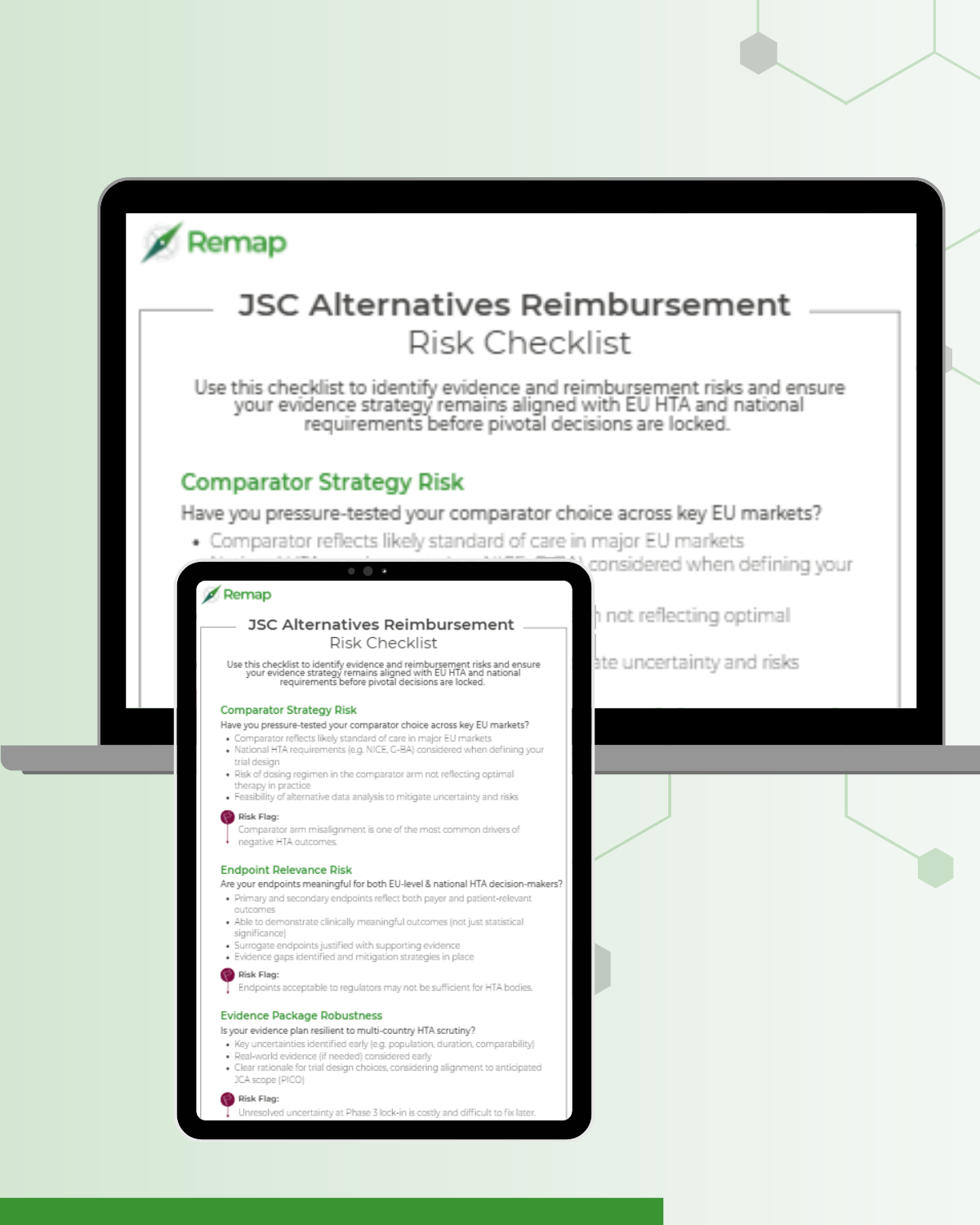
Early Evidence & Reimbursement Risk Checklist
A practical checklist to help teams assess whether early evidence decisions are setting them up for success — or problems — at reimbursement. Designed to surface risks early, before trial and evidence choices become difficult to reverse.
References
- https://www.sciencedirect.com/science/article/pii/S2666776225001747
- https://www.nice.org.uk/guidance/ta1091
- https://www.g-ba.de/bewertungsverfahren/nutzenbewertung/1115
- https://www.g-ba.de/bewertungsverfahren/nutzenbewertung/1118
- https://www.nice.org.uk/consultations/2971
- https://www.has-sante.fr/jcms/c_1625763/en/early-dialogues
- https://www.g-ba.de/themen/arzneimittel/arzneimittel-richtlinie-anlagen/nutzenbewertung-35a/informationen-fuer-unternehmen/beratung
- https://www.nice.org.uk/what-nice-does/life-sciences-how-to-get-your-product-to-market/nice-advice-service/strategic-and-scientific-advice
- https://www.nice.org.uk/news/articles/new-study-shows-nice-advice-support-can-reduce-appraisal-timelines-by-3-months
- https://remapconsulting.com/hta/hta-scientific-advice-pitfalls/